“Warfare” is the Most Realistic Depiction of Concussions and Brain Injuries on Film
Warfare is an unglamorous lesson in the trauma and horror of war, and a rare look at the effects and consequences of concussions and TBIs.

You might be familiar with one of these tropes: Our hero silently knocks out a henchman with a single gun-butt to the back of his head. Perhaps you’ve seen a protagonist get knocked out for a few minutes by a strong blow, only to wake up fully functional to continue the fight. Or maybe you’ve seen him take blows to the head, but shrug them off without consequence. If you’ve watched classic cartoons, you’ve undoubtedly seen a character hit so hard they are seeing stars, only to be set straight with a second whack to the head.
These tropes, and more, have been used in action movies, medical dramas, comedies, and cartoons for nearly a century. In these worlds, knockouts are nonlethal, tactical, temporary, maybe even comical, and always without any long-term consequences.
It's one of those things that I've rolled my eyes about when watching movies, but not something I’ve thought too much about, that is, until recently, when I saw the most realistic depiction of concussions and traumatic brain injury (TBI) on film.
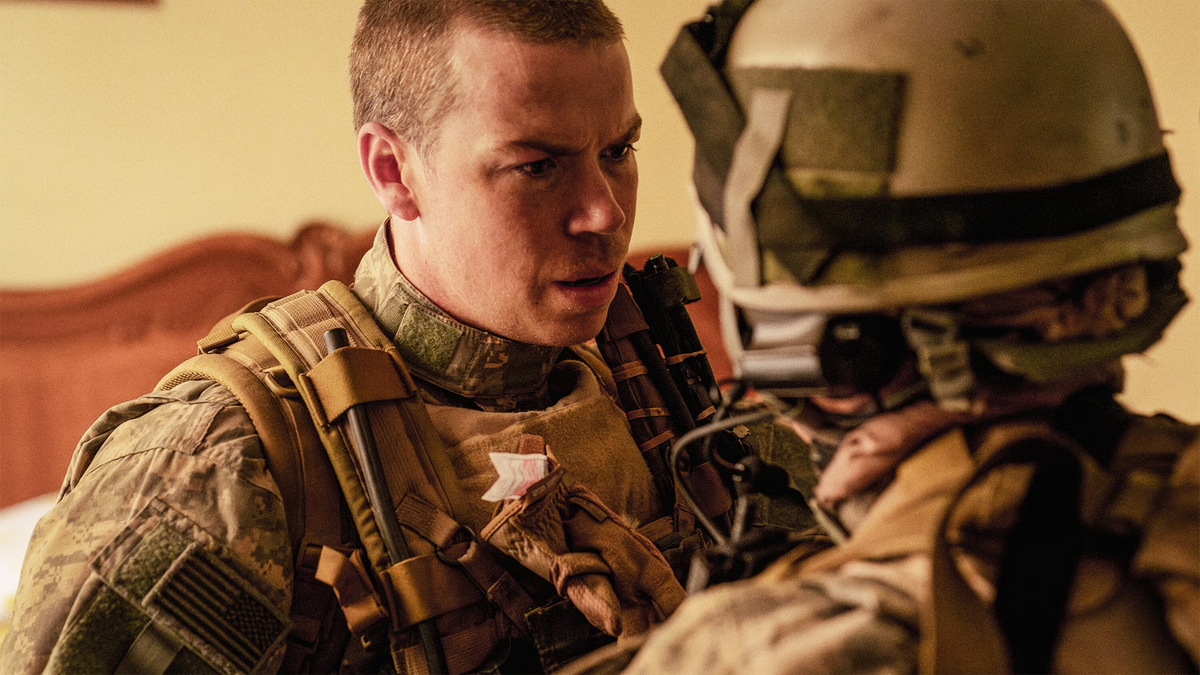
Warfare is a 2025 film based on the true story of U.S. soldiers in Ramadi, Iraq, in 2006. There are a few examples of traumatic brain injuries in the movie, none more striking than Will Poulter’s depiction of Erik, the officer in charge of a Navy SEAL platoon. We are embedded with Erik and his platoon in a two-story house during a surveillance mission.
For the first 30 minutes of the film, Erik is calm, confident, and in-control giving clear orders to his platoon and adapting quickly as they come under fire. Erik orders Claymore mines detonated to clear the perimeter, then gathers his team on the first floor to prepare for the arrival of a Bradley to evacuate one of their wounded.
Erik continues to give clear orders and relay information quickly, but after a few minutes, we see the first signs of possible head trauma. He starts blinking frequently, as if sensitive to light, then uncharacteristically hesitates, appearing confused for nearly 10 seconds before replying to a radio message. Later, he confides to a couple of the guys: “That fucking Claymore rocked me, dude. Rung my bell.” But unfortunately, this is just the start.
An IED explodes as the team moves out of the house to the Bradley. The blast kills one Iraqi soldier and catastrophically injures two Americans. The three SEALs in the rear, including Erik, don’t sustain any visible injuries, but are blown back and knocked unconscious. Those who can still stand are confused and unsteady as they get to their feet and try to make sense of what just happened.
After retreating back into the house, Erik radios another platoon for help. When they ask his location, he tries and fails to remember several times. With his frustration growing, he hoarsely shouts into the mic, “Look for the blood and the smoke! We’re there!”
Most of the action from this point is the platoon’s frantic work to save the lives of the most critically injured, but we can also observe the effects of the concussive blast on the others. The three men who were knocked out stare vacantly at the walls or floor and struggle to concentrate even while performing heroic, lifesaving work. Erik appears the most severely concussed. After providing some assistance to the injured, he wanders off, sits down, and stares blankly into space. When the other platoon arrives, he admits, “Dude, I’m fucked up,” before asking them to take the lead.
The movie ends with the SEALs exiting the house and boarding two Bradleys without any further incident. Although we don’t get to see the next day or their recovery, the quick glimpse we saw was one of the most realistic depictions of head trauma ever on film. The movie has almost no exposition or backstory, and lacks a traditional narrative, but that wasn't the type of movie the filmmakers wanted to make. They wanted to create “the most accurate war film possible,” relying solely on the first-hand accounts of the veterans involved. Warfare is an unglamorous lesson in the trauma and horror of war, and a rare look at the effects and consequences of concussions and TBIs.
Not every movie needs to depict concussions and their consequences exactly as Warfare does. Even if your goal is realism, every concussion and TBI can be different. Symptoms can be delayed by hours or days, present differently for each person, and recovery can vary as well, with some bouncing back within days and others struggling with symptoms for a long time.
However, I also think the realism of these injuries in fictional media matters. The problem isn't that some shows and movies depict unrealistic head injuries; it's that nearly all of them do. Not all media needs to be like Warfare. There are plenty of movies and TV shows that I love that are unrealistic in this and other ways. However, I also think that more media that accurately depict public health issues like concussions is always a good thing.
Follow Contagion for more updates on public health, politics, and media.